1 / 1


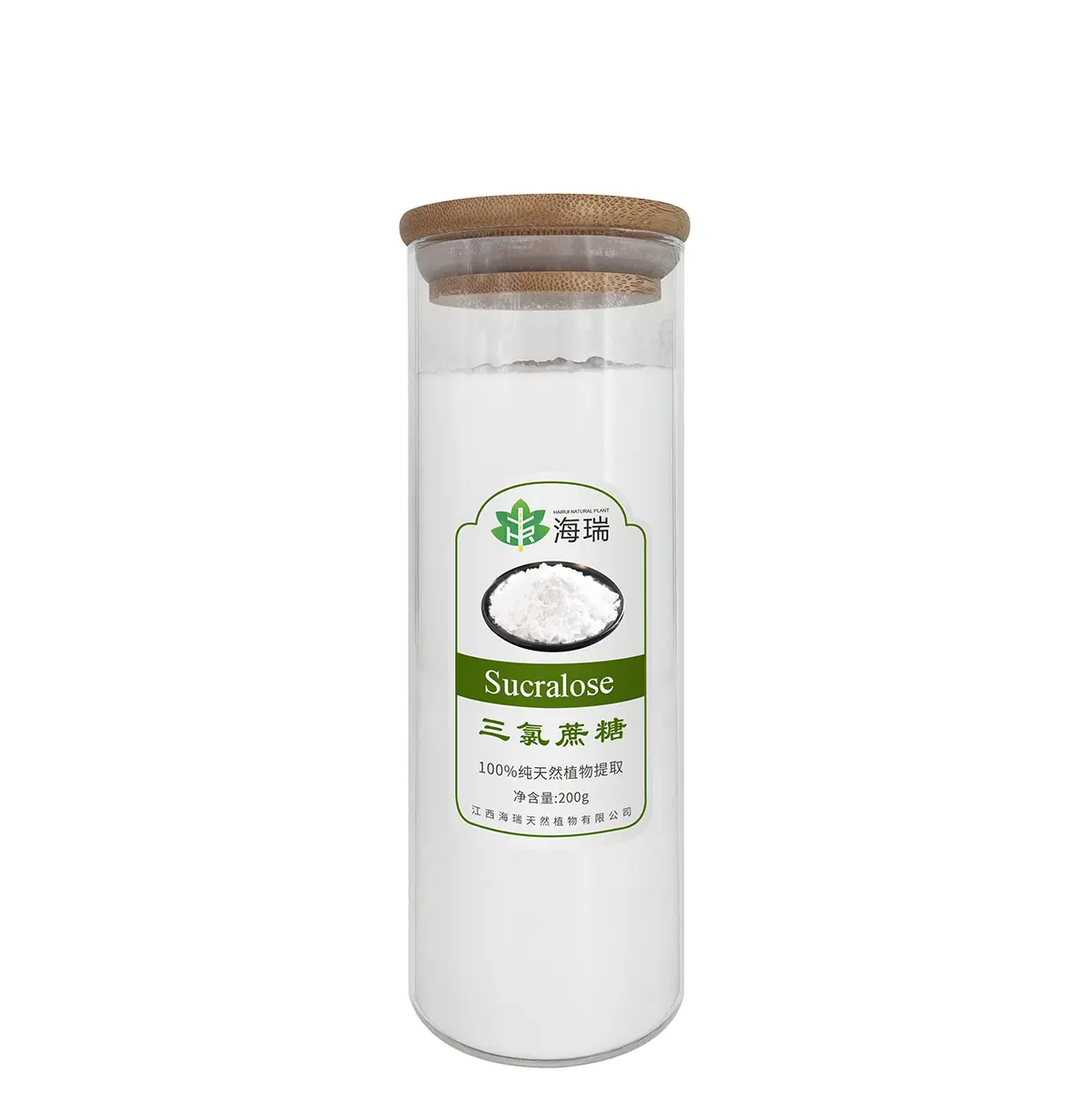
Sucralose is a white powder product that is easily soluble in water, ethanol and methanol. It is currently the only functional sweetener produced with sucrose as raw material. Its sweetness is 600 times that of sucrose, and its sweetness is pure. Its sweetness characteristics are very similar to sucrose, without any bitter aftertaste; it has no calories, does not cause tooth decay, and has good chemical stability, especially in aqueous solution. After a long period of toxicological tests, it has been proven that it is extremely safe and is currently the best functional sweetener. It has been approved for use in more than 30 countries including the United States, Canada, Australia, Russia, and China. At present, sucralose has been widely used in beverages.
Sucralose is a zero-calorie sugar substitute artificial sweetener. In the European Union, it is also known under the E number (additive code) E955. Sucralose is approximately 600 times as sweet as sucrose (table sugar), twice as sweet as saccharin, and 3.3 times as sweet as aspartame. Unlike aspartame, it is stable under heat and over a broad range of pH conditions and can be used in baking or in products that require a longer shelf life.

Sucralose has been approved for use in baked goods, baking mixes, non-alcoholic beverages, chewing gum, coffee and tea products, confections and frostings, fats and oils, frozen dairy desserts and mixes, fruit and water ices, gelatins, puddings and fillings, jams and jellies, milk products, processed fruits and fruit juices, sugar substitutes, sweet sauces, toppings and syrups. It can also be used as a "table-top sweetener" - added directly to foods by consumers.
The application of sucralose is more common in beverages. Because sucralose has good stability, it will not react with other substances, nor will it affect the transparency, color and flavor of the beverage.
Sucralose has the advantages of high temperature resistance and low calorific value. It is widely used in bakery products. The sweetness of sucralose products heated at high temperature will not change, and there is no loss of measurability.
The sucralose is used in candied foods, and the addition amount is controlled at 0.15g/kg. The main reason is that sucralose has good permeability, which can ensure the sweetness while avoiding other reactions.
Sucralose is a zero-calorie sugar substitute artificial sweetener made from sucrose. It appears as a white powder product that is easily soluble in water, ethanol, and methanol.
Sucralose is approximately 600 times as sweet as sucrose (table sugar), twice as sweet as saccharin, and 3.3 times as sweet as aspartame. It offers a pure sweetness similar to sucrose without any bitter aftertaste.
Yes, after long-term toxicological tests, it has been proven extremely safe. It is approved for use in more than 30 countries, including the United States, Canada, Australia, Russia, and China.
Yes, unlike some other sweeteners, Sucralose is heat-stable and remains stable over a broad range of pH conditions. Its sweetness does not change even under high baking temperatures.
It is widely used in beverages, baked goods, candied foods, jams, jellies, milk products, syrups, confections, desserts, ice cream, puddings, and can also be used directly by consumers as a table-top sweetener.