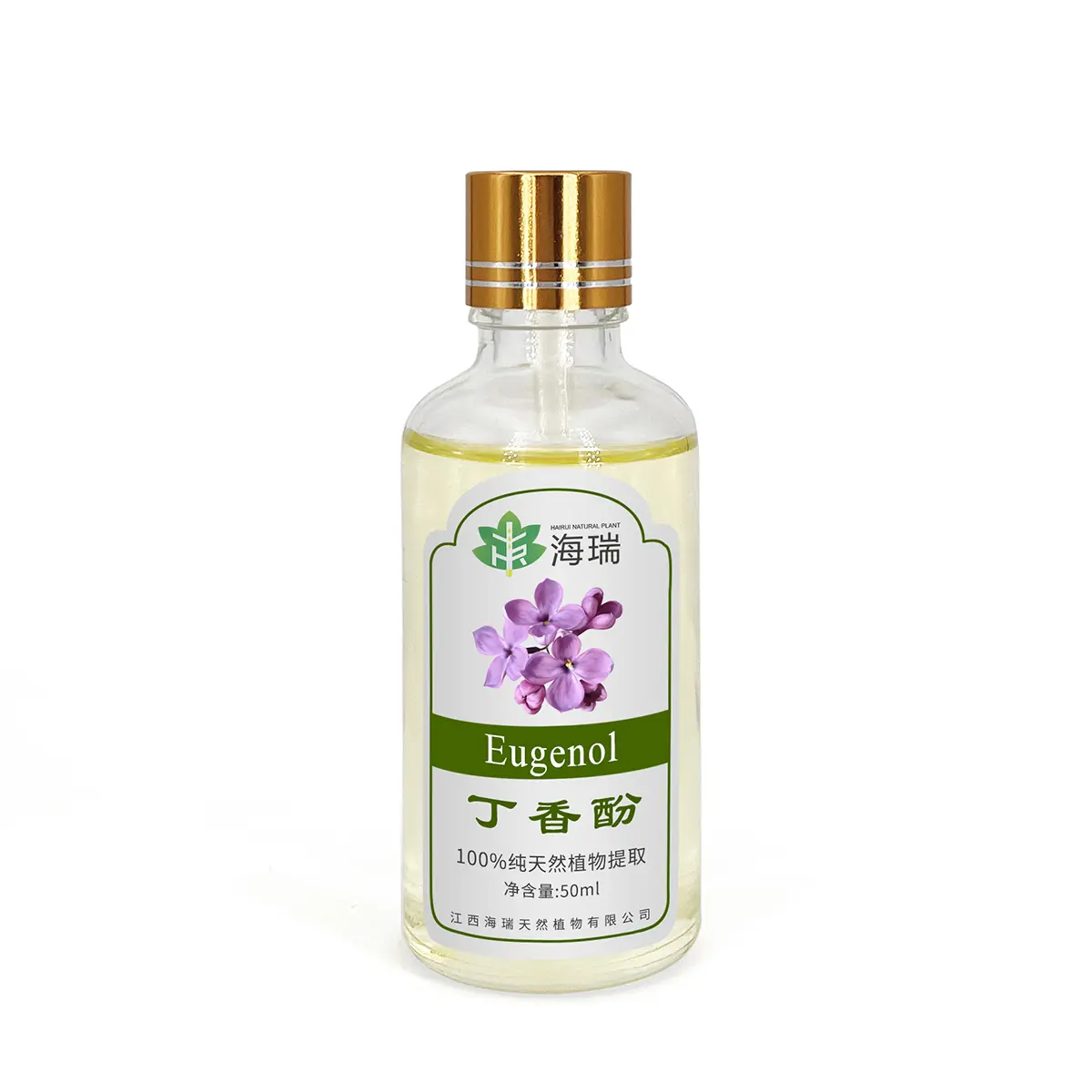
Eugenol occurs naturally in essential oils such as clove oil, clove basil oil, and cinnamon oil. It is a colorless to light yellow viscous oily liquid with a strong clove and spicy aroma.
The scientific name of eugenol is 4-allyl-2-methoxyphenol. The molecular formula is C10H12O2, and the molecular weight is 164.21. It is a colorless to light yellow viscous liquid with a strong clove spicy aroma. It is slightly soluble in water, miscible with alcohol, ether, chloroform, volatile oil, and soluble in glacial acetic acid and caustic alkali solutions. The color gradually becomes darker and thicker in the air. Metal ions such as iron and zinc can catalyze its oxidation, so the storage temperature should not exceed 25°C and it should be kept away from light. Eugenol can also turn red litmus blue, and it turns blue when it reacts with ferric chloride ethanol solution.
Eugenol Applications
Eugenol is a common pesticide ingredient with a wide range of applications. It is obtained through chemical synthesis and is commonly found in pesticides, fungicides and herbicides in agricultural production.
Insecticidal Effect
Eugenol has a killing effect on a variety of pests. Its insecticidal effect is mainly achieved by destroying the physiological metabolic process of pests, interfering with their nervous system and digestive system, and even causing them to suffocate. Eugenol pesticide is widely used to kill aphids, mites, termites, grubs, and other pests.
Bactericidal Effect
Eugenol has a bactericidal effect, which can prevent the growth and reproduction of pathogens, so as to achieve the purpose of preventing and controlling crop diseases. Eugenol pesticide is widely used in the control of plant diseases, such as bacterial wilt, anthracnose, late blight, gray mold, and so on.
Key Functions & Uses
Antibacterial properties and ability to assist in lowering blood pressure.
Strong overall sterilization force.
Used as local analgesic drugs for dental caries, providing both local relief and corrosion protection.
Utilized in perfume essence, various cosmetics essence, and soap flavor formulas.
Applicable for edible essence deployment.
Frequently Asked Questions
Q1: What are the natural sources of Eugenol?
Eugenol occurs naturally in essential oils such as clove oil, clove basil oil, and cinnamon oil.
Q2: What are the main physical properties of Eugenol?
It is a colorless to light yellow viscous liquid with a strong clove and spicy aroma. It has a molecular formula of C10H12O2 and a molecular weight of 164.21.
Q3: How should Eugenol be stored to prevent oxidation?
Since metal ions like iron and zinc can catalyze its oxidation, Eugenol should be kept away from light and stored at temperatures not exceeding 25°C.
Q4: How does Eugenol act as an agricultural pesticide?
Eugenol acts by destroying the physiological metabolic process of pests, disrupting their nervous and digestive systems, and causing suffocation. It is effective against aphids, mites, termites, and grubs.
Q5: Which plant diseases can be prevented using Eugenol's bactericidal properties?
Eugenol is widely used to prevent and control crop diseases such as bacterial wilt, anthracnose, late blight, and gray mold by inhibiting pathogen growth.
Q6: What are the industrial and medical uses of Eugenol?
Medically, it is used as a local analgesic and preservative for dental caries. Industrially, it is used in cosmetics, perfume essences, soap flavors, and edible essence formulations.